

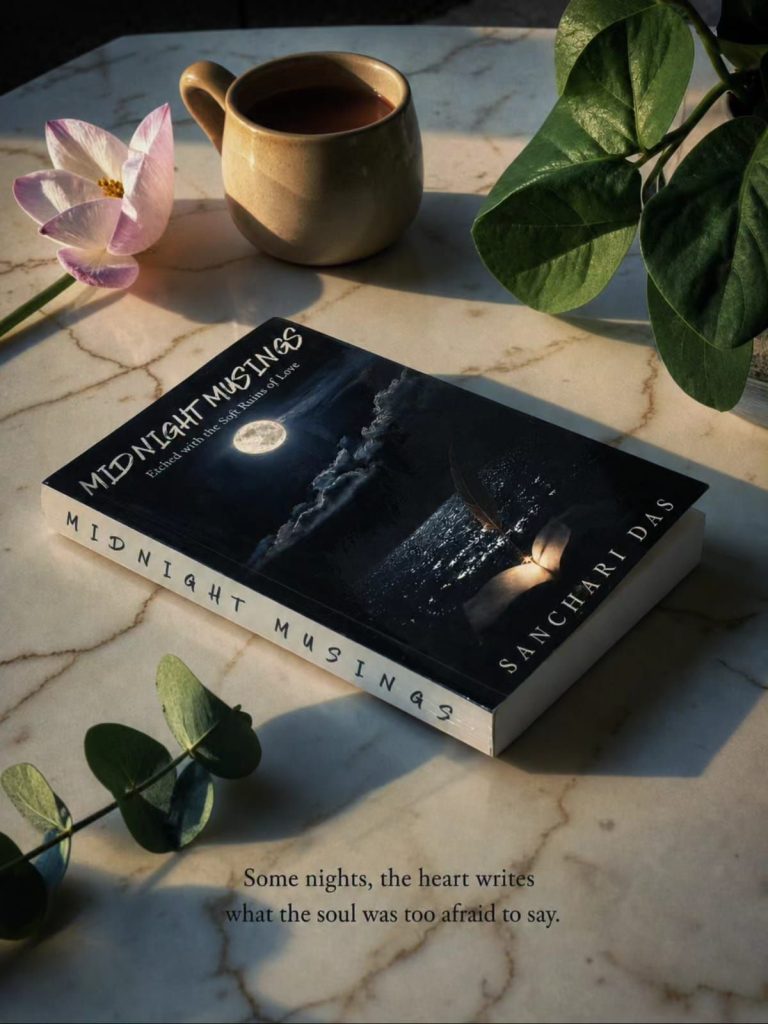
The Book at a Glance :
Midnight Musings by Sanchari Das is an intimate poetry collection about love, heartbreak, longing, memory, vulnerability, and the difficult process of healing. Rather than presenting heartbreak merely as an ending, the collection examines what remains after love fails, the memories, unanswered questions, emotional scars, and gradual journey towards acceptance.
It is a collection that does not attempt to dazzle through technical complexity. Instead, it seeks to make the reader feel. And in many places, it succeeds beautifully.

A Closer Look :
There are poetry collections that impress with technical brilliance, and then there are those that quietly settle into the reader’s emotional landscape long after the final page. Midnight Musings belongs unmistakably to the latter category.
It is not interested in dazzling the reader with intellectual acrobatics or obscure symbolism. Instead, it attempts something far more intimate: it invites us into the fragile architecture of a wounded heart and asks us to witness love not as a triumphant destination, but as an experience that continues to exist even after it has failed.
The title itself becomes a promise.
Midnight is that peculiar hour when distractions fade and honesty becomes unavoidable. It is when grief grows louder, memories refuse to sleep, and conversations we never had replay endlessly inside our minds. Sanchari Das understands this emotional geography remarkably well.
Her poems inhabit these nocturnal spaces where silence carries more weight than words, where longing becomes routine, and where healing is less about forgetting than learning to coexist with absence.
At the centre of the collection lies one compelling emotional truth: love does not necessarily lose its significance simply because it remains unreturned.
Rather than treating heartbreak as an unfortunate conclusion, Das presents it as a transformative force—one capable of reshaping identity, exposing vulnerability, and eventually revealing resilience. Throughout the collection, love becomes less a relationship between two individuals and more an internal conversation between hope and acceptance.
What immediately distinguishes the collection is its refusal to romanticize suffering while simultaneously refusing to dismiss it.
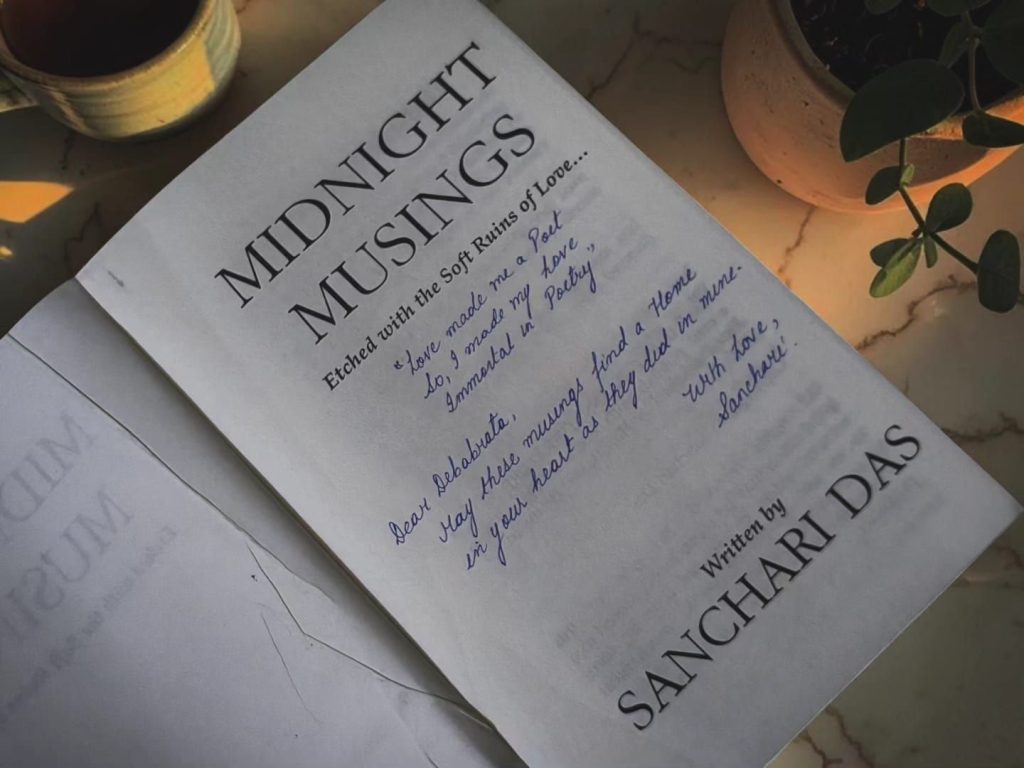
Contemporary poetry can sometimes swing between sentimental excess and detached minimalism. Das occupies a more delicate middle ground. Her poems acknowledge pain without glorifying it. They accept emotional devastation without reducing the speaker to victimhood.
The result is a voice that feels remarkably sincere.
The emotional landscape of Midnight Musings is constructed around recurring themes of unrequited love, abandonment, memory, emotional dependence, guilt, forgiveness, and self-discovery.
Yet what makes these familiar subjects compelling is the author’s willingness to expose their contradictions.
Love can be both comfort and captivity.
Memories can become both sanctuary and prison.
Letting go can appear desirable in theory while remaining almost impossible in practice.
These contradictions give the poems psychological authenticity because human emotions rarely follow neat logical patterns.
A collection that works cumulatively :
Many contemporary poetry collections rely heavily on quotable lines designed primarily for social-media consumption. Midnight Musings, however, functions somewhat differently.
While several verses are undeniably memorable on their own, the collection derives much of its strength from its cumulative emotional progression.
Individual poems often feel like diary entries written on different nights of the same heartbreak. Read together, they construct a slow emotional arc:
Denial → Longing → Self-blame → Emotional exhaustion → Acceptance → Quiet endurance

This progression is important because it prevents the collection from feeling like merely a compilation of isolated poems about heartbreak. Instead, it begins to resemble a sustained emotional conversation with oneself.
The beauty of simplicity :
Perhaps the greatest strength of Sanchari Das’s writing lies in its accessibility.
Her language remains uncomplicated throughout, but simplicity here should never be mistaken for artistic limitation.
Writing plainly while retaining emotional intensity is an enormously difficult balancing act. Das generally succeeds because her vocabulary never competes with her emotions. Instead, it allows them to emerge naturally.
There are moments when a single observation captures an entire emotional experience more effectively than an elaborate metaphor ever could.
This is perhaps why the collection can feel so personal to readers.
The poems rarely attempt to universalize heartbreak through grand abstraction. Instead, they focus on intimate emotional details. Paradoxically, it is this specificity that allows them to become universal.

Vulnerability as strength :
One particularly admirable quality is the author’s treatment of vulnerability.
Modern culture often celebrates emotional strength while quietly discouraging emotional openness. Midnight Musings challenges that contradiction.
Here, vulnerability is neither weakness nor performance. It is presented as an unavoidable consequence of loving deeply.
The poems suggest that emotional courage does not necessarily lie in avoiding pain. Sometimes, courage lies in surviving pain without abandoning one’s capacity to feel.
That idea gives the collection an understated philosophical depth.
Where the collection could have gone further :
The collection is emotionally effective, but it is not without its limitations.
Its greatest strength—its unwavering emotional consistency—occasionally becomes its greatest weakness.
Because most poems inhabit similar emotional registers of longing, melancholy, remembrance, and regret, the overall reading experience can sometimes feel tonally repetitive.
Heartbreak naturally repeats itself internally, but literature often benefits from sharper emotional contrasts. Greater variation in mood could have amplified the impact of the more devastating pieces.
Similarly, some poems revisit familiar imagery—empty nights, lingering memories, silent conversations, fading promises—with only subtle variations.
Individually, these images remain effective. Collectively, however, they occasionally reduce the element of surprise.
Readers accustomed to poetry rich in experimental metaphor, unconventional structures, or significant stylistic innovation may sometimes wish for greater boldness.
I also felt that the collection could have expanded its emotional gaze beyond romantic relationships.
Heartbreak is clearly its emotional foundation, but there are moments when one wishes the poet had explored other forms of human loss—friendship, family, identity, or existential solitude.
Such an expansion could have enriched the philosophical dimensions of the collection while preserving its emotional core.

Healing without forgetting
Perhaps the most remarkable achievement of Midnight Musings is the way it reframes heartbreak as a form of remembrance rather than merely loss.
The poems repeatedly suggest that healing does not necessarily mean the disappearance of pain.
Instead, healing means gradually learning to carry the pain differently.
Love leaves marks that neither time nor distance can completely erase. Rather than presenting this permanence exclusively as tragic, Das subtly suggests that these scars can also testify to our capacity for profound emotional connection.
There is an understated philosophical current running beneath the collection.
It quietly asks:
Does love require reciprocity to possess meaning?
Can love remain beautiful even when it fails?
Can memories nourish us as much as they wound us?
Is moving on synonymous with forgetting?
The collection does not provide definitive answers.
And perhaps that is precisely the point.
Poetry does not always need to solve emotional dilemmas. Sometimes its greatest purpose is simply to articulate them honestly.
What I Liked :
🔸 Emotionally authentic exploration of unrequited love and heartbreak.
🔸 Simple yet evocative language that remains accessible without sacrificing emotional depth.
🔸 Strong thematic consistency centred around vulnerability, memory, longing, and resilience.
🔸 An intimate reading experience that often feels like entering someone’s private emotional journal.
🔸 Several poems possess lasting emotional resonance and invite repeated reading.
🔸 Successfully transforms personal grief into a shared human experience.
🔸 Reflective philosophical undertones concerning love, loss, healing, and emotional endurance.
What Could Have Been Better :
▪️ The emotional tone occasionally becomes repetitive because of the recurring themes of longing and melancholy.
▪️ Greater stylistic experimentation and more varied poetic forms could have added artistic richness.
▪️ Certain images and emotional motifs recur frequently, reducing surprise in later sections.
▪️ The sequencing sometimes feels more diary-like than deliberately structured.
▪️ A wider exploration of non-romantic forms of loss could have added greater philosophical breadth.
Is Midnight Musings worth reading?
Yes—especially if you enjoy poetry that prioritizes emotional honesty over technical complexity.
Readers looking for experimental poetic structures or highly elaborate metaphors may find the collection comparatively restrained. But readers who want accessible, intimate and emotionally reflective poetry are likely to connect with it.
The book’s greatest achievement is not that it says something entirely new about heartbreak. Rather, it gives familiar emotions a sincere and recognisable voice.
Who should read Midnight Musings?
This collection would particularly appeal to readers who enjoy:
– Contemporary emotional poetry
– Poems about heartbreak and unrequited love
– Introspective and reflective writing
– Poetry about healing and self-discovery
– Accessible, emotionally driven literature
– Writing about vulnerability, memory and loss
Final Verdict :
Midnight Musings is not a poetry collection that demands admiration through technical brilliance; it earns affection through emotional honesty.
Sanchari Das writes with a quiet courage that refuses to hide behind elaborate language or fashionable ambiguity. Instead, she offers readers something increasingly rare—a sincere emotional document that acknowledges heartbreak without surrendering completely to despair.
Its imperfections stem largely from its unwavering commitment to a single emotional landscape. Yet even its repetitions can be understood as a reflection of grief itself. After all, grief is rarely linear. Memories return. Questions repeat themselves. Acceptance arrives and disappears. Healing moves forward and then unexpectedly takes us backwards.
In that sense, the collection’s emotional repetition is both its limitation and, at times, its authenticity.
For readers who seek poetry not merely to admire but to inhabit, Midnight Musings offers gentle companionship.
For those who have loved deeply, lost quietly, or simply wondered whether their unspoken emotions belonged only to them, the collection may feel particularly intimate.
It does not promise to mend a broken heart.
It does something quieter—and perhaps more meaningful.
It assures us that broken hearts, too, deserve beautiful language.
Frequently Asked Questions (FAQs) :
What is Midnight Musings by Sanchari Das about?
Midnight Musings is a contemporary poetry collection exploring love, heartbreak, unrequited feelings, memory, vulnerability, loss, self-discovery, and healing.
What are the major themes of Midnight Musings?
The major themes include unrequited love, heartbreak, abandonment, memory, emotional dependence, guilt, forgiveness, vulnerability, resilience, acceptance, and self-discovery.
Is Midnight Musings a good book for readers who enjoy emotional poetry?
Yes. The collection is particularly suited to readers who prefer accessible, introspective and emotionally driven poetry rather than highly experimental or technically complex verse.
What is the biggest strength of Midnight Musings?
Its biggest strength is its emotional authenticity. Sanchari Das transforms intimate experiences of love, loss and longing into emotions that many readers can recognise in their own lives.
What is the biggest weakness of Midnight Musings?
The primary limitation is its emotional and thematic repetition. The sustained focus on melancholy, longing and romantic heartbreak can occasionally make the collection feel predictable.
Does Midnight Musings focus only on heartbreak?
Heartbreak is its central emotional territory, but the collection also explores memory, vulnerability, forgiveness, identity, resilience and the process of healing.
Is Midnight Musings worth reading?
Yes, particularly for readers who enjoy emotionally honest contemporary poetry about love, loss, longing and healing.
Through My Lens :
Concept: ★★★★☆
Writing Style: ★★★★☆
Emotional Depth: ★★★★☆
Thematic Consistency: ★★★★☆
Overall: ★★★★☆
What stayed with me most about Midnight Musings is not any single definition of heartbreak, but the collection’s understanding that emotions do not simply disappear because a relationship does.
The book recognises something deeply human: sometimes we continue carrying people long after they have left our lives.
And perhaps healing is not about putting those memories down.
Perhaps it is about learning how to carry them without allowing them to crush us.
That is where Midnight Musings finds its quietest strength.
It understands that some wounds do not need grand solutions.
Sometimes, they simply need to be given words.