

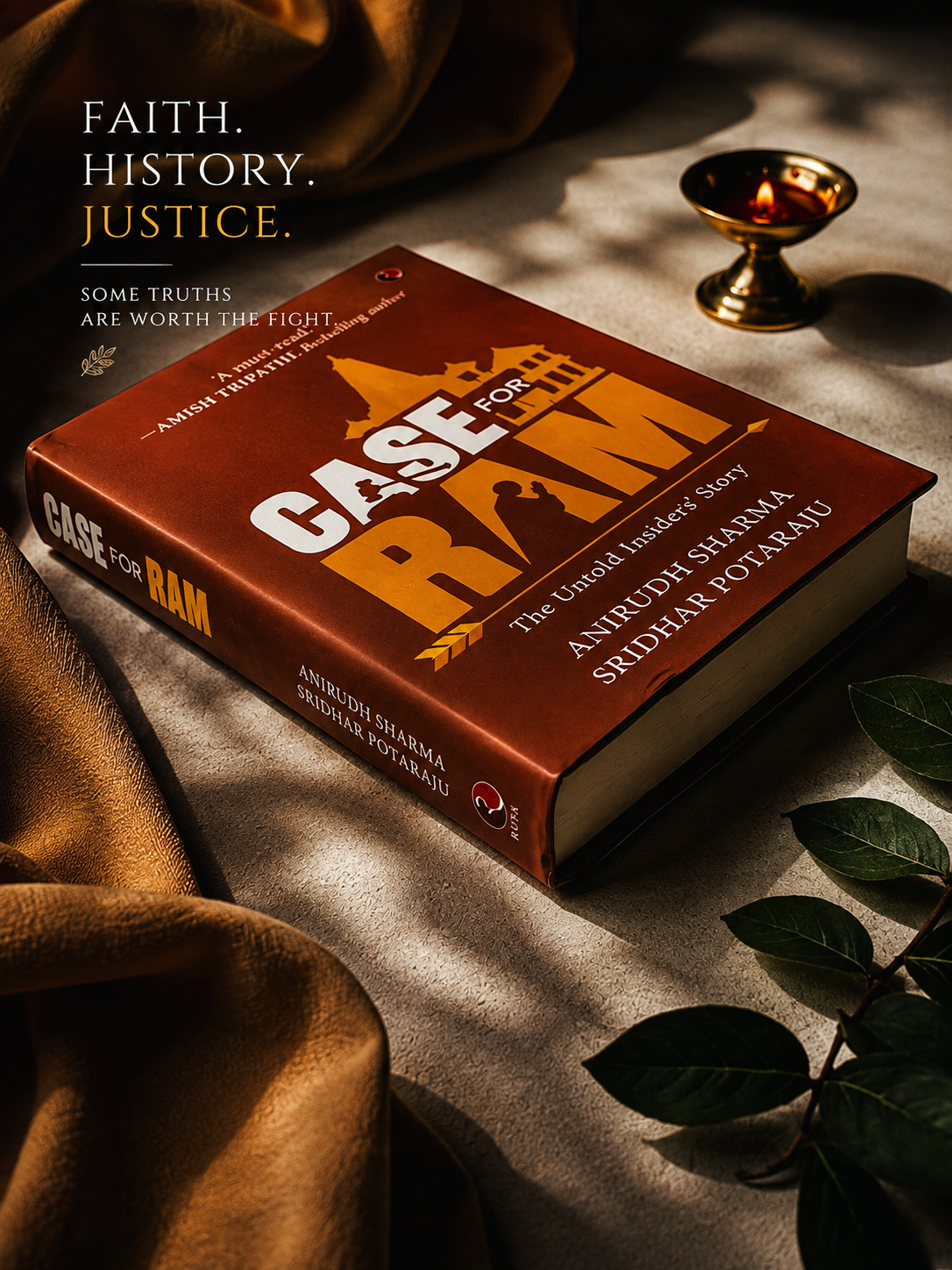
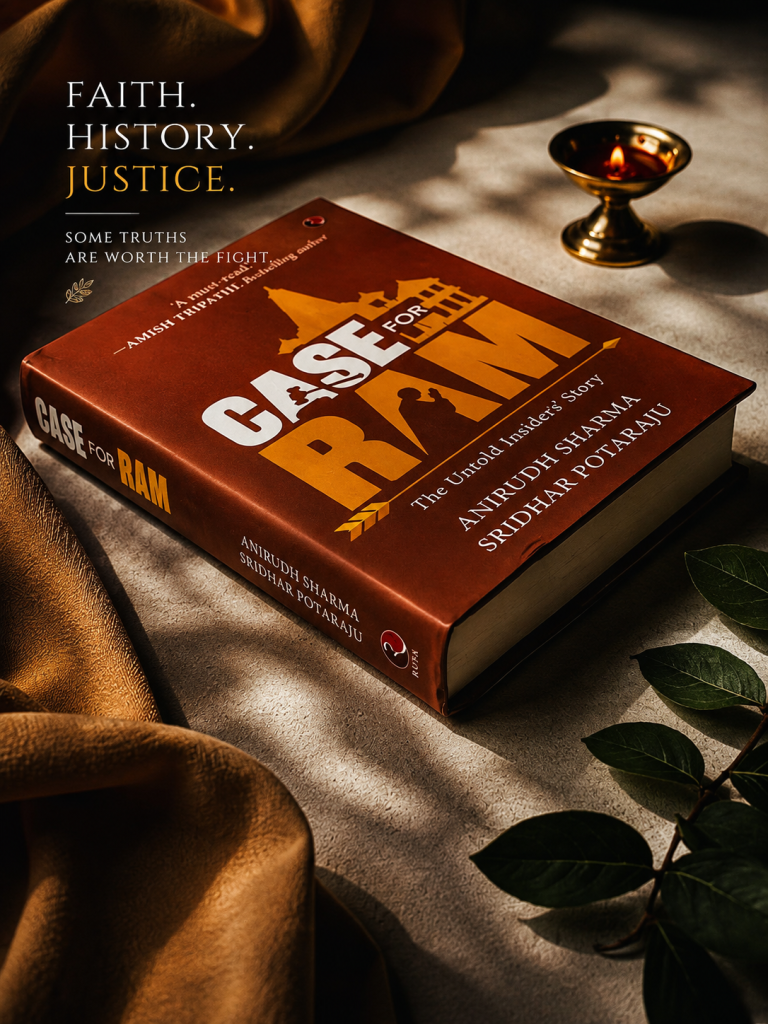
Author: Anirudh Sharma and Sridhar Potaraju
Genre: • Indian History • Law • Religion • Jurisprudence
Ideal for: Readers interested in the Ayodhya dispute, constitutional law, Indian history, jurisprudence, religious studies, and the intersection of faith and law
The Book at a Glance
What happens when divinity is summoned to the witness stand?
What does it mean when a deity becomes a juridical subject? And, perhaps more importantly, what does this reveal about a society attempting to negotiate faith through law while remaining anchored to constitutional morality?
Case for Ram approaches the Ayodhya dispute not merely as a legal chronicle but as a reflection of India’s civilizational anxieties, democratic resilience, and deeply contested historical memory.
The book attempts to translate one of India’s most emotionally charged, politically contentious, and historically layered disputes into a narrative accessible to the general reader.
In doing so, it becomes more than a retelling of a landmark legal battle. It becomes an examination of how religion, history, archaeology, evidence, jurisprudence, and constitutional institutions collided within one of the most consequential courtroom battles in modern India.
A Closer Look
The ambition of Case for Ram is immediately apparent.
The authors are not merely interested in telling readers what happened in the Ayodhya litigation. They attempt to recreate the atmosphere surrounding the case—the arguments, evidence, cross-examinations, personalities, historical claims, and extraordinary legal questions that accompanied it.
The result is occasionally reminiscent of a courtroom thriller.
Archaeological findings introduce unexpected turns. Historical records become objects of legal scrutiny. Lawyers engage in intellectual duels. Arguments that may initially appear overwhelmingly technical are gradually translated into language that a lay reader can follow.
This accessibility is one of the book’s most significant achievements.
When Faith Meets Law
At the heart of the book lies an extraordinary legal question: how does a constitutional court deal with a dispute deeply rooted in religious belief and historical memory?
The authors emphasize that the Supreme Court’s decision was not simply an endorsement of religious sentiment. The judgment engaged with evidence, including archaeological findings, historical records, revenue documents, travel accounts, and other material presented before the court.
This distinction is important.
Faith may provide the emotional and cultural foundation of a claim, but a constitutional court must examine what can be established within the framework of law.
The book’s most interesting contribution is therefore its attempt to show how faith and law can occupy the same narrative without being treated as interchangeable concepts.
Religion becomes the subject of legal examination rather than a substitute for legal reasoning.
That distinction gives the book much of its intellectual value.
The Courtroom as the Final Arena
Perhaps the most powerful thematic strand running through the book is the idea that a centuries-old civilizational dispute ultimately found its final institutional arena in the courtroom.
India’s legal system is hardly flawless. It is slow, complicated, and frequently frustrating.
Yet Case for Ram presents the Supreme Court as the institution through which competing historical and religious claims could ultimately be processed within a constitutional framework rather than through violence.
That is an important idea.
A society can carry centuries of memory, grievance, belief, and historical interpretation—and still choose institutions as the mechanism through which those conflicts are resolved.
The process may be painfully slow.
It may be imperfect.
But the very decision to submit an explosive dispute to law rather than force becomes historically significant in itself.
K. Parasaran and the Human Face of the Case
Among the personalities highlighted in the book, K. Parasaran occupies a particularly prominent position.
His age, devotion, discipline, and intellectual sharpness create a striking portrait of a lawyer approaching one of the most consequential cases of his career.
The authors sometimes emphasize his age and physical frailty to such an extent that it can become distracting. There are moments when one wishes the narrative would allow his legal intellect to speak more loudly than his physical circumstances.
Nevertheless, his presence adds a human dimension to what could otherwise become an overwhelmingly technical account.
It also reinforces a broader idea explored by the book: lawyers involved in historic litigation can become more than advocates. They can become carriers of memory, interpretation, institutional responsibility, and constitutional duty.
The Other Side of the Courtroom
One of the book’s strengths is that it does not completely reduce the opposing side to a caricature.
The authors acknowledge strong arguments presented by Muslim litigants and their legal representatives, which help prevent the narrative from becoming a straightforward triumphalist account.
This is particularly important given the emotional and political sensitivity of the subject.
However, this is also where the book could have gone further.
The Muslim litigants’ internal dilemmas, strategic choices, emotional experiences, and perspectives could have received considerably more attention. Greater exploration of these human dimensions would have produced a fuller and more symmetrical account of what was, after all, a dispute involving deeply held convictions on multiple sides.
When Legal History Becomes a Human Story
Another quality that makes Case for Ram engaging is its willingness to move beyond legal documents and courtroom arguments.
Personal reflections, admiration for prominent lawyers, the authors’ experiences surrounding the publication of the book, and even moments of perceived divine timing give the narrative an emotional dimension.
These details humanize the story.
At times, however, this emotional approach can also move close to devotional admiration.
That is not necessarily problematic in a work dealing with faith, but it does create moments where the boundary between personal reverence and neutral historical analysis becomes less distinct.
For readers seeking a strictly detached account, this may occasionally feel like a limitation.
What I Liked
🔸 Makes complex legal proceedings accessible to readers without a legal background.
🔸 Successfully transforms technical arguments, evidence, and cross-examinations into an engaging narrative.
🔸 Avoids simplistic triumphalism by acknowledging significant arguments presented by both sides.
🔸 Provides useful historical and archaeological context for understanding the Ayodhya dispute.
🔸 Shows how religion, history, archaeology, and constitutional law became intertwined within the litigation.
🔸 The courtroom atmosphere occasionally gives the book the momentum of a legal thriller.
🔸 Personal reflections add warmth and humanity to an otherwise highly technical subject.
🔸 Encourages reflection on the role of institutions in resolving deeply polarising disputes.
What Could Be Better
▪️ The repeated emphasis on K. Parasaran’s age and physical vulnerability occasionally distracts from the substance of his legal contribution.
▪️ At certain points, the treatment of the Hindu litigant side can become admiring enough to affect the appearance of analytical neutrality.
▪️ The Muslim litigants’ personal experiences, internal dilemmas, and litigation strategies deserved greater attention.
▪️ More engagement with competing historiographical interpretations could have strengthened the historical analysis.
▪️ Readers seeking a strictly academic legal treatment may find the personal and devotional elements somewhat prominent.
Why Does Case for Ram Matter?
The significance of Case for Ram lies beyond the Ayodhya dispute itself.
The case raises fundamental questions about the relationship between faith and constitutionalism.
Can religious belief be examined through legal institutions?
Can historical memory become the subject of judicial scrutiny?
Can archaeology and documentary evidence influence questions deeply rooted in religious tradition?
And can a constitutional democracy provide an institutional framework for disputes that carry enormous emotional weight?
These questions make the book relevant beyond the immediate case.
The Ayodhya dispute serves as a lens through which the reader can examine India’s complex relationship with religion, history, identity, law, and democracy.
Is Case for Ram Worth Reading?
Yes, particularly for readers who want an accessible introduction to the legal and historical dimensions of the Ayodhya dispute.
It is especially valuable for readers who may find conventional legal writing intimidating but want to understand the arguments, evidence, personalities, and historical context surrounding the case.
Those seeking a completely detached academic treatment may find certain passages more emotionally or devotionally inclined than expected. Nevertheless, the book’s accessibility and narrative momentum make it a worthwhile read for anyone interested in one of India’s most consequential legal disputes.
Who Should Read This Book?
This book would particularly appeal to:
- Readers interested in the Ayodhya dispute
- Students of Indian constitutional law
- Readers interested in jurisprudence and religious law
- Students and general readers of modern Indian history
- Readers interested in archaeology and historical evidence
- Those interested in the relationship between religion and constitutional democracy
- Readers curious about the personalities and courtroom strategies behind landmark litigation
Final Verdict
Case for Ram is more than a courtroom chronicle.
It is an attempt to capture the legal, historical, emotional, and civilizational anatomy of the Ayodhya dispute.
Its greatest achievement lies in making an extraordinarily complicated legal battle understandable without reducing it entirely to legal jargon. It demonstrates how evidence, archaeology, historical records, religious belief, and jurisprudence converged within a courtroom dealing with a dispute that had already shaped India’s social and political consciousness for generations.
The book is informative without becoming excessively academic, emotive without being entirely sentimental, and balanced enough to acknowledge the strength of arguments presented from both sides.
Its shortcomings are largely matters of perspective and depth. The narrative occasionally leans towards admiration of the Hindu litigant side, while the Muslim litigants’ human and strategic dimensions receive comparatively less attention. A more extensive engagement with competing historiographical interpretations could also have strengthened the work.
Yet the larger question the book leaves behind is more significant than victory or defeat.
It asks us to consider what happens when a civilization’s deepest memories enter a constitutional courtroom.
Perhaps the answer is found not simply in the verdict, but in the process itself.
A deeply divisive dispute was ultimately channeled through evidence, arguments, institutions, and law.
And that may be the book’s most enduring idea:
Even the most combustible conflicts can, however slowly and imperfectly, be placed before institutions rather than settled through force.
Frequently Asked Questions
What is Case for Ram about?
Case for Ram examines the legal, historical, archaeological, and cultural dimensions of the Ayodhya dispute, focusing on the arguments and evidence presented during the landmark litigation.
What makes Case for Ram different from a conventional history book?
The book combines legal history with courtroom storytelling, historical context, personal reflections, and discussions of evidence, making a complex legal dispute more accessible to general readers.
Does the book discuss the Supreme Court’s Ayodhya judgment?
Yes. The book focuses substantially on the legal proceedings and the reasoning surrounding the landmark Supreme Court case.
Is Case for Ram suitable for readers without a legal background?
Yes. One of its major strengths is its attempt to translate complex legal arguments and courtroom proceedings into accessible prose.
What are the major themes of Case for Ram?
The major themes include faith and law, constitutional morality, historical memory, archaeology, jurisprudence, religious identity, institutional justice, and the relationship between civilisational claims and constitutional institutions.
Does the book present both sides of the Ayodhya dispute?
The book acknowledges important arguments from both sides, although its treatment of the Muslim litigants’ internal experiences and perspectives could have been more extensive.
What is the biggest strength of Case for Ram?
Its biggest strength is its ability to make complicated legal proceedings, evidence, and courtroom arguments understandable and engaging for the general reader.
What could have been better?
Greater exploration of the Muslim litigants’ experiences, more historiographical debate, and a more consistently detached treatment of devotional elements could have made the book more analytically comprehensive.
Reader’s Take
What stayed with me most about Case for Ram is not simply the question of who won the legal battle.
It is the larger question of how a democracy handles a dispute that carries centuries of faith, memory, grievance, and identity.
The book reminds us that justice is rarely instantaneous. Institutions can be slow, imperfect, and frustrating, but their significance becomes most visible when society faces questions that could otherwise tear it apart.
In that sense, Case for Ram is ultimately less about a courtroom victory and more about the extraordinary journey of taking one of India’s most combustible civilizational disputes through the long, difficult, and dignified path of law.
Historical Context: ★★★★★
Legal Insight: ★★★★☆
Writing Style: ★★★★☆
Accessibility: ★★★★☆
Overall: ★★★★☆