

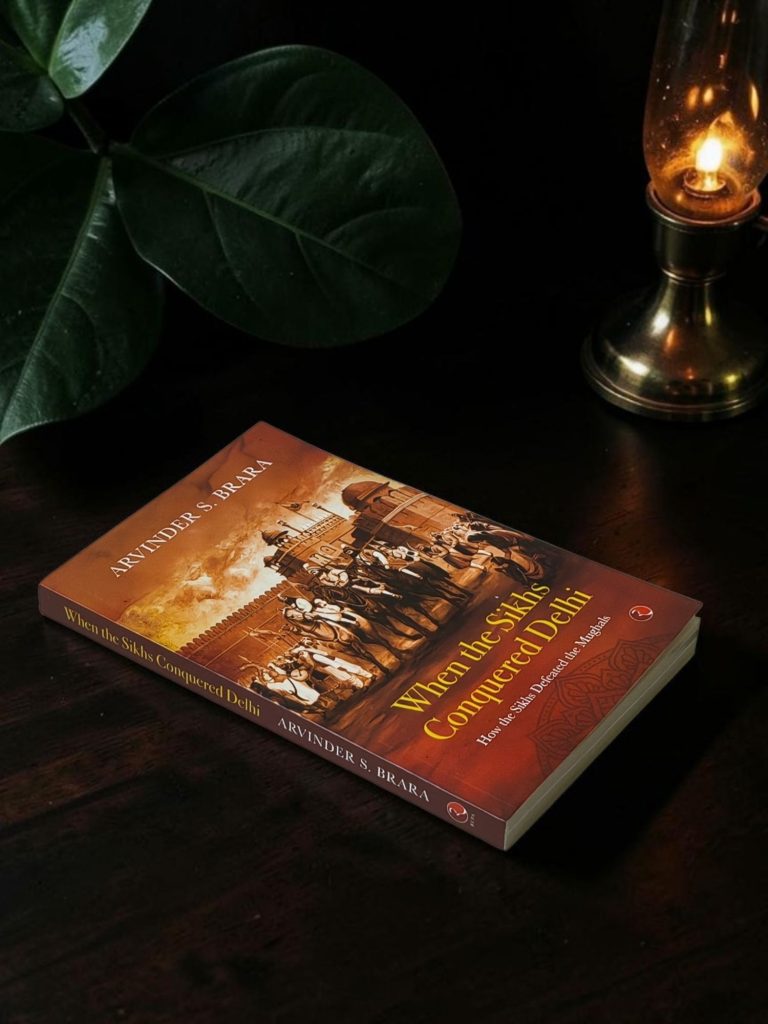
Author: Arvinder S. Brara
Genre: History • Sikh History • Indian History
Ideal for: Readers interested in Sikh history, Punjab, religious history, political transformation, warfare, and the evolution of Sikh power
Historical Context: ★★★★☆
Writing Style: ★★★★☆
Depth: ★★★★☆
Presentation: ★★★★☆
Overall: ★★★★☆
The Book at a Glance
Some history books tell you what happened. The better ones make you understand why it still matters. When the Sikhs Conquered Delhi by Arvinder S. Brara attempts the latter, tracing the Sikh journey from the teachings of Guru Nanak Dev Ji to the emergence of Sikh political authority, with particular emphasis on the long historical process that eventually culminated in the Sikh conquest of Delhi.
Rather than treating the conquest as a standalone military achievement, the book attempts to place it within the much larger story of Sikh faith, persecution, resistance, identity, organisation, and political transformation.
At its heart, this is a book about how a community shaped by spiritual principles gradually developed the institutional and military strength to challenge established political powers.
A Closer Look
Even before the first page, the book announces its ambitions.
Its burnt-orange palette, cavalry imagery, and Red Fort backdrop evoke the grandeur and violence of another age. The cover has the visual quality of a historical painting—dramatic without becoming unnecessarily ornate.
That visual language prepares the reader for the world the book intends to explore: a history shaped by faith, conflict, resistance, power, and survival.
What makes the book particularly engaging is that Brara does not simply rush towards the conquest of Delhi.
He builds towards it.
The journey through the Sikh Gurus, persecution, Sikh-Mughal tensions, the emergence of the Misls, and the rise of Maharaja Ranjit Singh provides the political and ideological context necessary to understand how Sikh power developed.
Delhi, therefore, becomes more than a geographical destination.
It becomes a symbol of political authority—and the journey towards it becomes a story of transformation.
From Spiritual Community to Political Power
One of the more interesting aspects of the book is the way it presents Sikh history as a process rather than a collection of disconnected battles.
The Sikh tradition begins with the spiritual and ethical teachings of Guru Nanak Dev Ji, but the historical circumstances surrounding the community gradually change the nature of its engagement with political power.
Persecution, conflict, institutional development, military organisation, and collective resistance all contribute to this transformation.
The result is a historical narrative in which Sikh identity cannot be separated completely from the political realities surrounding it.
The book therefore encourages the reader to consider an important question:
How does a spiritual community respond when its principles come into conflict with political power?
The answer, as the historical trajectory presented here suggests, is not simple.
Faith becomes resilience.
Resilience becomes a collective identity.
And collective identity eventually becomes political power.
The Importance of Context
A major strength of the book is its attempt to provide historical continuity.
The conquest of Delhi could easily have been presented simply as a military episode—a moment of victory surrounded by dates, battles, commanders, and political developments.
Instead, the broader narrative gives that episode greater significance.
The reader is encouraged to understand that military achievements do not emerge from historical isolation. They are products of institutions, leadership, social organisation, collective memory, and circumstances accumulated over generations.
This approach makes the book more accessible to readers who may know individual episodes of Sikh history but want to understand how those episodes connect to one another.
Sikh Identity and Resilience
Another important dimension is the book’s exploration of Sikh identity.
The history presented here is not merely about territorial expansion or military victories. It is also about how a community responds to adversity and develops a sense of collective purpose.
Persecution and resistance become recurring elements in the historical narrative, but the significance lies in how those experiences contribute to community formation.
This makes the book particularly relevant beyond military history.
At its deeper level, it is concerned with questions of identity:
What allows a community to survive sustained pressure?
How does collective memory influence political consciousness?
When does resistance become an essential part of identity?
These questions give the historical narrative contemporary relevance.
Where the Book Could Have Gone Further
The book is engaging and accessible, but there are areas where greater analytical depth could have strengthened it.
One limitation is the relatively limited engagement with contrasting historiographical perspectives.
History is rarely a single uncontested narrative. Different historians can interpret the same political development, conflict, or military episode differently depending on their sources, methodology, and historical framework.
A more explicit engagement with these competing interpretations would have made the book even more valuable for readers interested in historical scholarship.
Similarly, some aspects of internal Sikh politics and competing political interests could have received greater analytical attention.
Historical communities are rarely completely unified, and examining internal disagreements, rivalries, and competing interpretations can often make a historical account more nuanced.
There are also episodes where additional contextual detail could have helped readers unfamiliar with the period understand the broader political environment.
These limitations do not undermine the book’s central narrative, but they occasionally leave the reader wanting more.
What I Liked
🔸 A coherent historical progression rather than a simple battle-by-battle chronicle.
🔸 Strong exploration of Sikh identity, resilience, and political transformation.
🔸 Accessible prose that makes a potentially complex historical journey approachable.
🔸 Effective connection between religious principles and political history.
🔸 The decision to place the conquest of Delhi within a much longer historical trajectory.
🔸 A visually striking presentation that complements the subject matter.
🔸 The book encourages readers to think about history in terms of identity and memory rather than merely dates and events.
What Could Be Better
▪️ Greater engagement with contrasting historiographical perspectives would have added scholarly depth.
▪️ More detailed analysis of internal Sikh politics could have made the narrative more nuanced.
▪️ Some historical episodes could have benefited from additional contextual explanation.
▪️ Greater discussion of competing interpretations of important events would have strengthened the analytical dimension.
▪️ Readers already familiar with Sikh historiography may occasionally want more complexity and debate.
Why Does the Conquest of Delhi Matter?
The significance of the conquest lies not simply in the capture of a city.
Delhi has historically represented political authority in the Indian subcontinent. Consequently, the Sikh presence in Delhi can be understood as part of a much larger story about the changing distribution of political power.
Seen in this context, the conquest becomes symbolic.
It represents the point at which a community that had endured persecution and developed through resistance could assert itself within the larger political landscape of North India.
That is what makes the book’s historical journey compelling.
The destination matters, but the transformation required to reach that destination matters even more.
Is When the Sikhs Conquered Delhi Worth Reading?
Yes, particularly for readers who want an accessible introduction to the historical journey of Sikh political development and the broader context surrounding the conquest of Delhi.
It will be especially interesting to readers fascinated by Sikh history, Punjab, religious communities, political transformation, warfare, and the relationship between faith and power.
Readers looking for a highly academic historiographical study may desire more engagement with competing scholarly interpretations, but as a narrative-driven historical account, the book offers a compelling journey through an important period.
Who Should Read This Book?
This book would particularly appeal to:
– Readers interested in Sikh history
– Students and general readers of Indian history
– Readers interested in Punjab’s political history
– Those fascinated by the relationship between religion and political power
– Readers interested in military and resistance history
– Anyone wanting to understand the historical background of Sikh political authority
Final Verdict
When the Sikhs Conquered Delhi succeeds because it understands that history is never merely about the past.
It is about memory, identity, power, resilience, and the meanings communities carry forward.
Arvinder S. Brara’s book places the conquest of Delhi within a much larger historical journey—from the spiritual teachings of Guru Nanak Dev Ji, through persecution and resistance, to the organisation and political assertion of the Sikh community.
Its greatest strength is this sense of historical progression.
The conquest does not appear suddenly. It emerges from everything that came before it.
The book may not answer every historical question, and readers seeking extensive historiographical debate may wish for greater analytical complexity. Yet it succeeds in making an important historical trajectory accessible and engaging.
More importantly, it leaves the reader with a question that extends beyond the pages of the book:
What happens when faith becomes resilience, resilience becomes collective identity, and identity eventually reshapes power?
Perhaps that is why the history remains relevant.
Because the conquest of Delhi was not simply about winning a battle.
It was about what a community had become by the time it reached the gates of power.
Frequently Asked Questions
What is When the Sikhs Conquered Delhi about?
The book explores Sikh history and political development, tracing the journey from the teachings of Guru Nanak Dev Ji through persecution, resistance, Sikh-Mughal conflicts, the Misls, and the rise of Sikh political power, with particular emphasis on the conquest of Delhi.
Who wrote When the Sikhs Conquered Delhi?
The book is written by Arvinder S. Brara.
What are the major themes of the book?
The major themes include Sikh identity, faith, resistance, persecution, political transformation, military power, collective memory, and the relationship between religious principles and political authority.
Does the book focus only on the conquest of Delhi?
No. The conquest is placed within a much longer historical narrative. The book examines the developments that contributed to the emergence of Sikh political and military power.
Is the book suitable for beginners interested in Sikh history?
Yes. Its accessible prose and chronological progression make it suitable for general readers who want to develop a broader understanding of Sikh history.
What is the biggest strength of the book?
Its biggest strength is its attempt to connect individual historical episodes into a coherent story of Sikh political transformation rather than presenting history simply as a sequence of battles.
What could have been better?
Greater engagement with competing historiographical perspectives, internal Sikh political dynamics, and alternative interpretations could have added greater analytical and scholarly depth.
Reader’s Take
What stayed with me after reading When the Sikhs Conquered Delhi is the idea that historical victories rarely begin on the battlefield.
They begin much earlier—in ideas, institutions, collective memory, resilience, and identity.
The conquest of Delhi therefore feels less like an isolated moment and more like the culmination of a long historical transformation.
And perhaps that is the most valuable thing a history book can do: not simply tell us what happened, but make us understand why it mattered then—and why it continues to matter now.